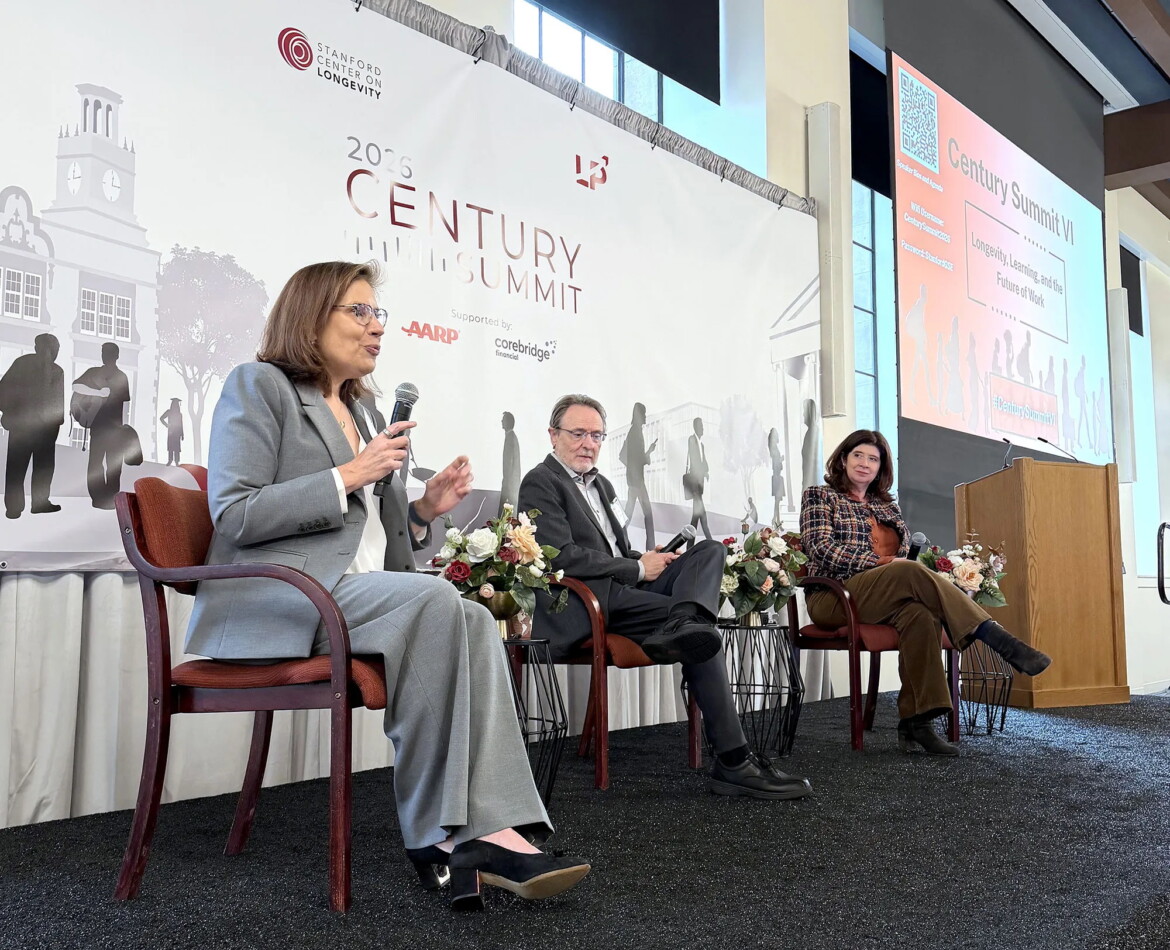
The old model — work until you’re 65, retire, golf, die — is gone. With average life expectancy having increased by 30 years over the last century, people need to think differently about work. And that means thinking differently about learning.
That was the message at the Century Summit VI conference sponsored by the Stanford Center on Longevity and The Longevity Project, “Longevity, Learning and the Future of Work,” on Tuesday and Wednesday. The conference featured panels of experts from academia, business, nonprofits, media, and government considering radical ways to provide the lifelong learning that people will need to navigate longer work lives.
“This conference is where employment meets education,” said Stanford sociologist and professor of education Mitchell Stevens, co-director of SCL.
That premise was underscored both by the location of the conference — the Stanford Graduate School of Education — and the question posed in the opening session: What if longevity and learning weren’t separate worlds? Or, as SCL Associate Director Martha Deevy put it, “continuous learning becomes mandatory” as people need to finance their longer lives.
The first question to emerge was whether and how people can continue to work longer in a world that still overvalues youth. Despite chronic talent shortages and declining birthrates, many employers have not moved to “capture the bounty” of older workers, said Tracey Layney, a human resources expert and former executive vice president and chief human resources officer at Levi Strauss & Co.
Peter Cappelli, professor of management at Wharton, offered a blunter assessment: The failure to hire older workers “is because of discrimination,” he said, adding that such bias makes no sense. Older workers are committed workers, out of the child-rearing years, and experienced. The problem “is not that there isn’t a need or that they’re not good at” working, Cappelli argued. So “you just have to start suing people.”
Whether or not more lawsuits are the answer, there was a strong consensus that longer work lives will be essential to all generations alive today and those to come, especially given the quickly changing landscape of AI. “We’ll all have to re-skill much more frequently than we thought,” Deevy said.
Learning has lifelong benefits
While many people associate the term “longevity” with older people, speaker after speaker emphasized that an increased lifespan has consequences for people of every age. Chandra Muller, a sociology professor at the University of Texas at Austin and principal investigator for a research project on healthy aging called EdSHARe, reported on findings that students who took more math and science in high school did better in navigating later life stresses. Students who attended well-resourced schools had higher mid-life cognitive function. These studies at the high school level undercut old assumptions about the importance of a 4-year college degree and reinforce “the lifelong benefits of investing in young people’s education,” said GSE professor Stevens.
Alternatives to traditional school models — and a distinction between formal “education” and the learning that can happen anywhere, anytime — cropped up repeatedly from the multi-sector panelists and audience. Dr. Mara Woody, director of strategic partnerships at the learning platform Riipen, spoke about the importance of bringing real-world projects into the education curriculum to get away from the catch-22 of needing experience to get a job and needing a job to get experience.
Jodi Anderson Jr. described a project he founded, Rézme, that helps adults who have criminal records (estimated to be 80 million-plus), as well as veterans and neurodiverse candidates, understand the laws and programs available to help them re-enter the workforce.
Teaching people new skills throughout their lives has been a mission at Stanford’s School of Engineering for over 70 years, said Carissa Little, the School’s Associate Dean of Global and Online Education. Recognizing that engineers’ knowledge quickly becomes outdated has led the school to create programs that have served over 22.4 million learners with credentialed, non-degree education.
William Gaudelli, Inaugural Dean of Georgia Tech’s new College of Lifetime Learning, said the college’s goal is to “future-proof” learning by offering students at any age a way to re-tool and gain new skills. To date, the college has reached over 100,000 learners around the world.
Some of the ideas involved stepping away from traditional models of education altogether. GSE’s Mitchell directed the group to the Learning Society, a coalition of SCL and other partners building on the idea that “all kinds of learning count.”
Dr. Paul J. LeBlanc, a Visiting Scholar at the Harvard Graduate School of Education, described starting with a blank slate to redesign what learning looks like and create “precision learning” options tailored to the individual. One of the results of that process, a short film called “Butterflies,” features a Lakota boy on the Pine Ridge Indian Reservation in South Dakota using AI to connect with a Michoacana girl in Mexico to save Monarch butterflies. It’s rare to see people in tears at a 2-day longevity conference but there you go.
Talent mobility, senior gap years, other ideas
Other panels included employers who have already incorporated planning for longer lives into their strategies. Sarah Chapman, Chief Marketing Officer for Manulife Investment Management, described her organization’s $350 million investment in the Longevity Institute, aimed at helping people “live more years in good health.” Anne Thevenet-Abitbol, Vice President of Prospective and New Concepts at Danone, described the company’s innovative personal development program, Octave. The program is based on the idea that, as with a piano, a good performance requires using the entire keyboard: “all the generations have a contribution to make.”
Subarna Malakar, North American Inclusion Leader at Sanofi North America, said that the pharmaceutical company promotes “talent mobility” — including letting employees try completely new fields within the organization — as a key part of employee retention efforts.
Panels on intergenerational workforces showcased models of work and learning that cut across age barriers. Hope Chicago is helping both high school students and their parents get post-secondary credentials. Arielle Galinsky, MPP/JD candidate at the Harvard Kennedy School and Yale Law School and a fellow with Co-Generate, founded the now-national Legacy Project as an undergraduate at Tufts University to bring “youngers” and “olders” together to share their stories.
No idea was off the table. Allison Aubrey, Food & Health correspondent for NPR News, brought in the notion of a “gap year” where adults could take a portion of their Social Security benefits well before they turn 65 to re-tool and rethink their path forward. That idea collapsed once the health insurance problem came up, but it epitomized the outside-the-box theme of the conference.
As for what’s happening already, Gov. Wes Moore of Maryland, in a videotaped interview, said that his state is the first to offer all high schoolers a paid one-year service option following graduation. “There is no one size fits all” for education, Moore said, adding that his state is working to “support lifelong learning at every stage of life.”
In California, Stewart Knox, Secretary of the California Labor and Workforce Development Agency, reported on the state’s Jobs First program that created more than 61,000 jobs and trained or re-trained more than 142,000 workers, including older adults, in 2025. His advice to an 18-year-old starting college now applied to everyone in the room, as well as the 2,000 online attendees: “Be willing to change.”