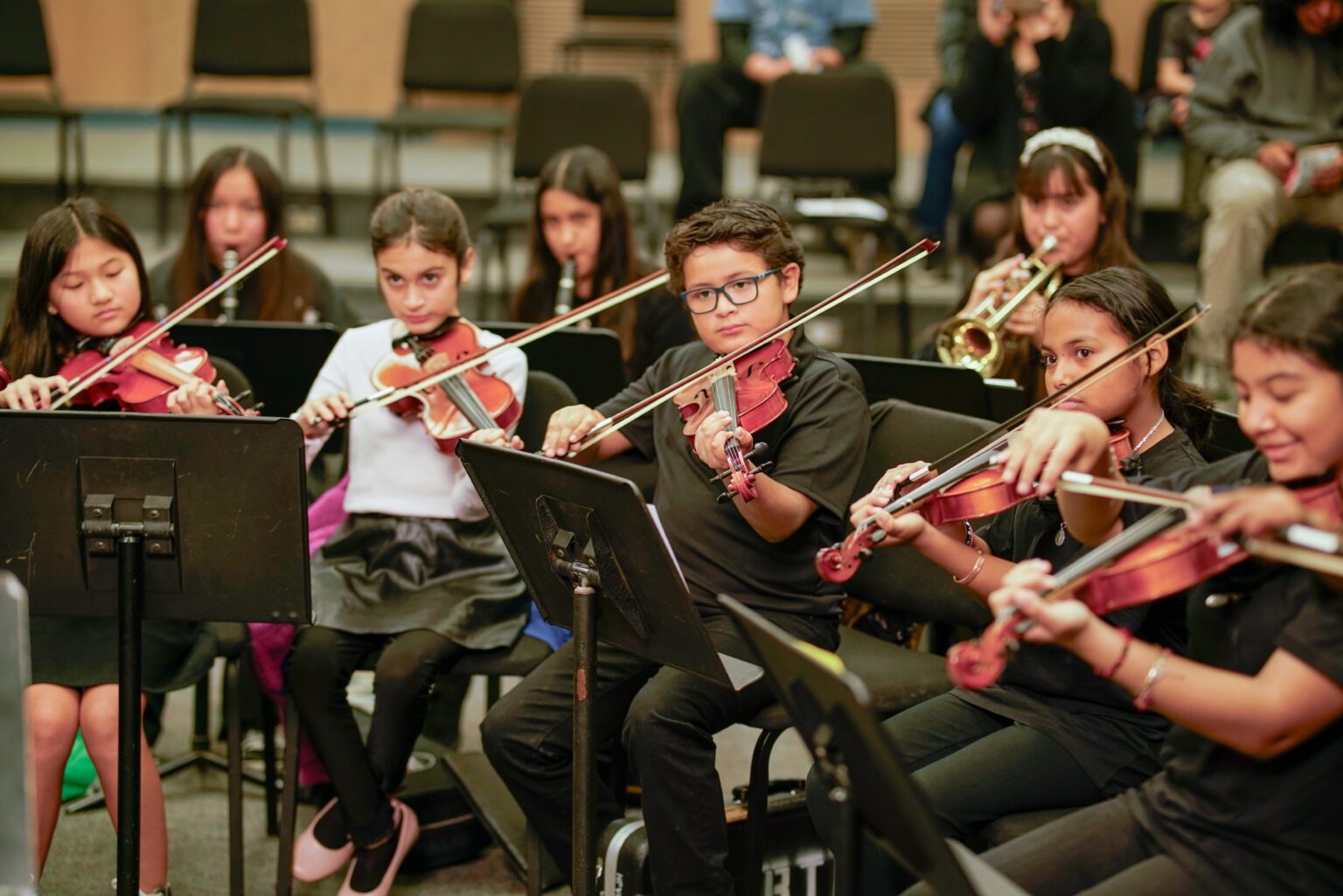
The Arts and Music in Schools Act, the historic arts education mandate that greatly expanded the role of the arts in California classrooms, is receiving a boost in specialized educators to teach arts education in K-12 schools.
Making it possible is the newly launched $11.5 million Arts Education Accelerator Fund, which will span five years. Led by nonprofits such as the Hewlett Foundation and California Community Foundation, the fund aims to address the shortage of qualified arts educators in California. That will include developing new arts teacher training, credentialing and apprenticeship programs for visual arts, theater, dance and other performing arts in California schools.
“The benefit of the Arts and Music in Schools Act is that there [is] funding for a large number of new visual and performing arts credentialed and certificated staff. And because the jobs just hadn’t existed before, we know there wasn’t a pipeline for the workforce,” said Tom DeCaigny, co-chair of the fund’s advisory board and program officer at the Hewlett Foundation. “So, our strategy is to be supporting programs that are going to help bring the next generation of visual and performing arts educators into schools.”
The Arts and Music in Schools Act, passed in 2022 with Proposition 28, sets aside roughly $1 billion a year for arts education programs in TK-12 public and charter schools.
Nearly 90% of California schools failed to meet state requirements for arts education before the act, and more than 5,500 arts teachers are currently needed statewide, according to a 2025 study by the nonprofit research institute SRI.

Alfredo Guzman, a visual arts teacher at Holtville High School in Imperial County, said he worked with arts education advocacy group Create California to help his school district hire two additional arts teachers for junior high students, most of whom had no access to arts programs before Proposition 28 passed. Guzman, who also serves on a local chapter of the California Arts Council, said many school leaders remain unclear on spending requirements for the arts.
“I’ve seen that schools will spend money real quick without really having a plan, and then they’ll have to walk stuff back because they don’t have space, or they can’t find teachers, or don’t work with their community,” Guzman said. “It’s about finding teachers, and it’s about districts being organized and not spending the money in the spring or misusing funds.”
DeCaigny of the Hewlett Foundation said the fund has awarded an initial grant to the Californians Dedicated to Education Foundation, a fiscal manager for the California Department of Education, to develop higher education programs to train visual and performing arts teachers. The fund will also bring together a panel of groups such as Create California, the California County Superintendents Educational Services Association and the Learning Policy Institute to identify solutions for implementing expanded arts programming in schools.
The fund, which includes the Herb Alpert Foundation, the Fox Foundation and the Music Man Foundation, also aims to address disparities in arts access in low-income and rural communities, which have some of the lowest student-participation rates in arts education in California, DeCaigny said.
Penelope Oliver, a sophomore at UC Berkeley and founder of Sacramento-based arts education nonprofit All Access Arts, said she hopes the accelerator fund allows more young students of color, who are underrepresented in the arts educator workforce, to pursue careers in arts education.
“The arts made me who I am. It got me through hard times. It created a community. It made me feel like I mattered and I belonged,” Oliver said. “How can we replicate this for other kids who do not have access to that and who are also facing hardship?”
In Guzman’s visual arts classroom at Holtville High, no two classes are the same. He identifies the skills students are most interested in, such as basic drawing, and structures his classes around those interests, pushing students to experiment with their own ideas, he said. He’s seen students who struggle in core classes excel in his, and he’s helped them learn to express themselves creatively and cope with their mental health issues.
“We’ve partnered with nonprofits to make shoes for kids. We designed a mural. We’ve done mosaics on campus,” Guzman said. “And when students see their work as something that’s helping other people and having an effect on the community, they take pride in their work. They see, ‘What I do matters.’”
Students with access to arts education are five times less likely to drop out of school, four times more likely to be recognized for academic achievement and four times more likely to earn a bachelor’s degree, according to the National Endowment for the Arts.
“There’s no education without an arts education,” Oliver, the UC Berkeley sophomore, said. Investing in the arts means “we are investing in the future of our state, our future leaders. So, I’m very excited for what that means.”