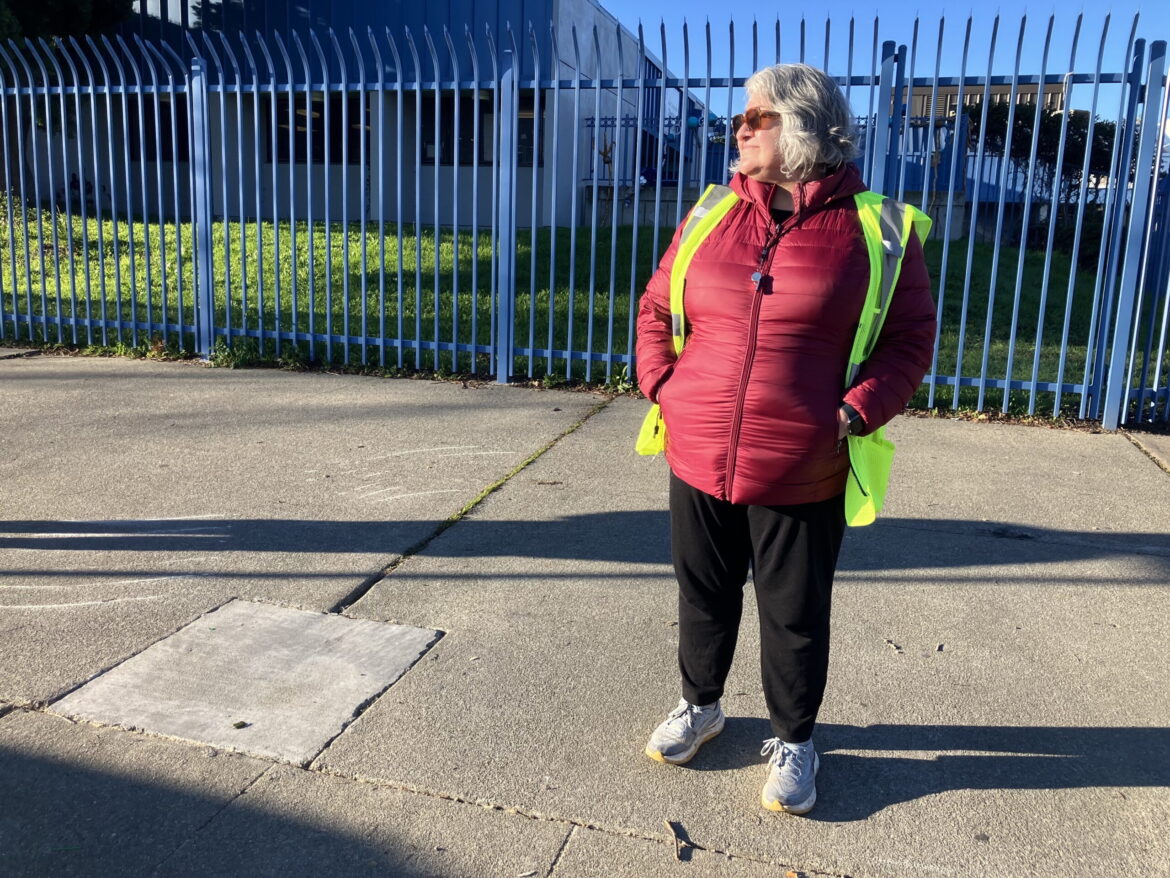
A recent morning was abuzz outside the joint campus of Esperanza Elementary School and Korematsu Discovery Academy in East Oakland. A crossing guard walked parents and children across the street, cars pulled up to the curb to drop off students, and families lined up to buy tamales and champurrado, a hot drink made of corn and chocolate, sold from the trunk of a car.
Watching it all was a mom from another school, Larisa Casillas, wearing a neon green vest and a whistle around her neck. She walked up and down the block, scanning approaching vehicles, on the lookout for Immigration and Customs Enforcement, or ICE, agents.
Casillas is part of a growing number of parents, teachers and neighbors who have banded together in districts across the state, including Oakland, Los Angeles and San Diego, to watch for ICE agents outside schools, walk students to school, and bring groceries for families who are afraid to leave their homes.
School leaders across the state said the efforts have helped improve students’ mental health and increase attendance, which in some cases had declined because of fears of immigration enforcement.
In January 2025, the Trump administration rescinded a policy that had prohibited immigration enforcement near or in schools, hospitals and places of worship. “This action empowers the brave men and women in CBP and ICE to enforce our immigration laws and catch criminal aliens. … Criminals will no longer be able to hide in America’s schools and churches to avoid arrest,” a Department of Homeland Security spokesperson said in a press release.
The change in policy sparked concern among teachers, principals and superintendents that parents would keep students home out of fear. Some schools have seen attendance drop for days after immigration enforcement.
California legislators responded with laws meant to limit immigration enforcement in schools, requiring agents to obtain a warrant signed by a judge to enter schools and for schools to notify parents, staff and students if ICE agents are on campus.
Parents like Casillas responded with patrols.
“Just the idea that they’re going to schools and targeting parents and children, it’s just extra mean-spirited, you know, going out of your way to traumatize a community; it’s just infuriating,” Casillas said.
Oakland hasn’t seen the same kind of intense immigration enforcement activity as Los Angeles, Chicago, Charlotte, or Minneapolis, but Imai Hong said it helped to have an organized network of teachers, parents and community members when ICE agents were spotted near Hoover Elementary School in West Oakland in November. Dozens of people rushed to the school to protest. From the sidewalk, they sang children’s songs for the students inside.
“It was really beautiful how folks showed up,” Imai Hong said.
A spokesperson for the Alameda County Office of Education, which has provided vests and flyers for the volunteers, said in a statement that it is doing so because it “is committed to improving attendance at all of our schools, in particular for our most vulnerable students.”
The Trump administration has characterized some organized actions to monitor ICE, including filming them, as “interfering” with operations and endangering officers.
“Violence is anything that threatens them and their safety, so it is doxing them, it’s videotaping them where they’re at when they’re out on operations,” Homeland Security Secretary Kristi Noem told reporters in July.
But federal courts have ruled that filming law enforcement in public is lawful and protected under the First Amendment, and California law prohibits charging people with obstruction for filming police activity in public.
Volunteers in Oakland said they were trained to keep a distance from agents to avoid allegations of obstruction.
“Everything we’re doing is legal and protected activity,” said Imai Hong.
Alma Torres, a mother of both elementary and high school students in Oakland, said even though she is a U.S. citizen, she has been worried about ICE agents detaining her family members, neighbors, or other parents in her community. Seeing volunteers outside her children’s schools has helped alleviate some of her fears.
“Seeing that there’s someone who is watching out for our safety, both physical and emotional, made me feel calmer,” she said.
In other districts, including San Francisco and San Diego, parents and teachers have organized to help walk students to school. Some teachers and parents have also organized rides for students whose families are afraid to leave their homes.
In August, during the first week of school in San Diego, federal immigration officers detained a father outside an elementary school while he waited to pick up his child. San Diego Unified School District Superintendent Fabiola Bagula later said during a California Department of Education webinar that the incident spread fear among parents, but the community response helped improve attendance.
“What I’ve seen is the community rising up, saying, ‘We’re not going to stand for this, and actually we’re going to walk each other’s children to school,’” Bagula said.
In Los Angeles and San Diego, teachers cruise neighborhoods in the early morning before school to look for ICE, said Lupe Carrasco Cardona, a Los Angeles ethnic studies teacher and chair of the Association of Raza Educators (Los Angeles).
She said in addition to patrolling the streets, teachers have fundraised to bring grocery store gift cards and bags of rice and beans to families who were afraid to leave their homes after hearing about immigration raids. During the winter break, they also brought toys to children.
“If they’re worried about food, housing insecurity, their parents not being there when they come home, how can you teach them? In a perfect world, I would eradicate those issues. But in this world, we are just doing what we can,” Carrasco Cardona said.
She said this year, many students, especially recent immigrants, stopped coming to school. Some started working after their parents were detained or deported. One student said the help the teachers gave her family helped motivate her to apply to college, and she was just accepted to several universities with a full scholarship.
“They’ve lived in such fear they were almost paralyzed, and she wasn’t even going to come to her senior year,” Carrasco Cardona said. “We had to assure her that we’re going to do anything we can to protect her.”
Tierre Mesa, a middle school principal in Oakland, said the patrols have had a positive impact on the students, who see the community’s support in action.
“There’s so much messaging in the media right now that makes our students and families feel like they’re not cared for and that they’re not wanted, and for our kids particularly, that there’s something wrong with them,” Mesa said. “To see people showing up every day in support of them is just hugely important.”
Imai Hong said principals have told her too that the patrols improve attendance.
“Parents were feeling more confident bringing their kids to school, knowing that there were another set of eyes keeping a lookout,” she said. “That to me really drove home that we’re actually out here as much to protect access to education as we are here to deter ICE abductions.”