Special holiday presentations and trippy new releases are on the bill this week.
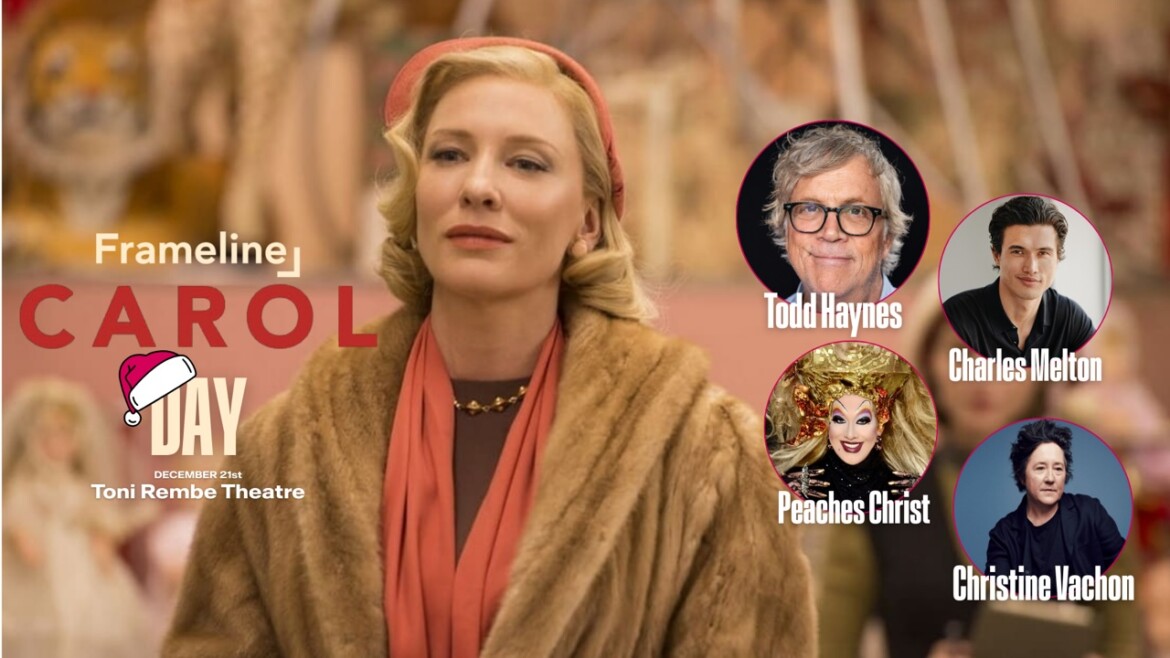
Fast becoming a holiday tradition, Frameline’s “Carol” Day is back with its third edition on Dec. 21 at San Francisco’s Toni Rembe Theatre. It includes a 10th-anniversary screening of Todd Haynes’ lesbian gem “Carol,” plus a live appearance by Haynes, who will receive the Frameline Queer Lens Award for Filmmaking. Producer Christine Vachon and actor Charles Melton will join Haynes. Adapted by Phyllis Nagy from a Patricia Highsmith novel, Haynes’ richly romantic melodrama follows two 1950s women (played by Rooney Mara and Cate Blanchett) who meet at a New York department store at Christmastime and soon embark on a secret affair. Visit frameline.org for ticket information.
Floating Features, a sailing cinema project put together by the Roxie Theater and Red and White Fleet, is showing popular holiday movies aboard the hybrid electric vessel Enhydra. Upcoming attractions, handpicked by the Roxie, include “How the Grinch Stole Christmas” (2000), screening on Dec. 19; “The Muppet Christmas Carol” (1992) on Dec. 20; “A Christmas Story” (1983) on Dec. 26; and “National Lampoon’s Christmas Vacation” (1983) on Dec. 27. Boarding takes place at Red and White Fleet, Pier 43 1/2, San Francisco. Cruises begin at 6 p.m. For ticket prices and more details, visit redandwhite.com or roxie.com.
Terry Zwigoff (“Crumb,” “Ghost World”), known for his movies about individualists and misfits, and for his contributions to San Francisco’s underground comix scene, returns Roxie at 6:30 p.m. Dec. 17 to present documentary “Louie Bluie” and the “Director’s Cut” of the cult-popular holiday comedy “Bad Santa.” Zwigoff will discuss and sign Criterion remasters of both.
“Suburban Fury,” directed by Robinson Devor (“The Woman Chaser”), tells the story of Sara Jane Moore — who, 50 years ago, attempted to assassinate President Gerald Ford — from Moore’s warped but compellingly expressed perspective. The nonfiction thriller consists of interviews conducted with Moore (whose agreement to appear on camera stipulated that she be Devor’s only interviewee) and archival materials relating to San Francisco’s colorful, crazy 1970s radical political scene. The film follows Moore from her West Virginia beginnings to her conservative suburban married life to her radicalization in San Francisco, inspired by events including the kidnapping of Patricia Hearst by the Symbionese Liberation Army. Moore also recalls her activities as an FBI informant and her conversion to the ideology of groups she was recruited to spy on.

(Suburban Fury via Bay City News)
The story culminates in September 1975, when, in downtown San Francisco, Moore fired two shots at Ford and missed because something was wrong with the gun. Moore, who served 32 years of a life sentence, believed that her act would trigger a violent revolution that would bring down the government. While not all her statements are off-beam — she makes sense when talking about the CIA’s efforts to assassinate or overthrow foreign leaders — Moore, self-important and prone to overstatement, is a problematic subject. Lacking versions of events other than hers, the film has narrative holes and distorts facts. But it also has sterling archival items: TV excepts, newspaper items, footage of the Hearst kidnapping, the Black Panthers, antiwar protests and Cesar Chavez’s labor-rights marches show the revolutionary and passionate landscape Moore functioned in. She emerges as a fascinating reflection of those times. “Suburban Fury” opens Dec. 19 at the Roxie. Devor will appear in conversation on Saturday after the 3 p.m. show.

With its hallucinatory storytelling and 160-minute running time, “Resurrection,” from Chinese filmmaker Bi Gan (“Long Day’s Journey Into Night”), won’t win trophies for clarity or restraint. But this phantasmagorical consideration of dreams, movies and desire is too imaginative and sensorially extraordinary to reject. Bi immerses viewers in a world where, in exchange for immortality, people have relinquished their ability to dream. We follow a pro-dream dissenter, a shape-shifting “Deliriant,” played by Jackson Yee, over several chapters. Each represents a different cinematic style and 20th-century period. Shu Qi plays a mysterious woman who enters the Deliriant’s dreams. A chapter resembling a silent movie features a Nosferatu-like figure. A noirish wartime chapter includes a “Commander,” a mysterious suitcase and mirror-shop violence that brings to mind Orson Welles’ “The Lady From Shanghai.” In the final chapter, set at the end of the century, a charismatic tough falls for a vampire. Not all of the chapters are compelling, and Bi’s penchant for dream logic can make the plot a head-shaker. But the colorful and striking imagery and continuous takes (special mention goes to cinematographer Dong Jingsong) are often amazing; Bi’s ambitious, sweeping filmmaking reminds us of what cinema can be. “Resurrection” opens Thursday at the Roxie.

Also coming to the Roxie on Dec. 16 is “We Shall Not Be Moved,” director Pierre Saint-Martin’s award-winning satirical black-and-white dramedy about generational trauma stemming from a horrible event in modern Mexican history. Luisa Huertas plays Socorro, a retired lawyer obsessed with finding the soldier who killed her brother during the violently silenced student protests in October 1968 in Mexico City’s Tlatelolco Square. When a new lead emerges, nearly six decades later, Socorro seeks revenge. Huertas received Mexico’s Best Actress Ariel Award.
The post Movies: ‘Carol’ Day, Xmas films on the water, ‘Suburban Fury,’ ‘Resurrection,’ ‘We Shall Not Be Moved’ appeared first on Local News Matters.