Top Takeaways
- California will maintain its current student vaccination requirements despite President Trump’s new executive order.
- State health officials warned that the Trump administration’s recent announcement might cause confusion among families.
- California reported 58 measles cases so far this year, a marked increase from 25 in 2025.
As schools reopen amid a national surge in measles cases, California students will continue to follow the state’s existing vaccination requirements, despite President Donald Trump’s latest effort to change the country’s childhood vaccine schedule.
California has the authority to determine which immunizations are required for students to attend school. The state will continue to follow guidelines created by the American Academy of Pediatrics and other experts, said Dr. Erica Pan, director of the California Department of Public Health (CDPH) and the state’s public health officer.
The executive order, issued Aug. 10, calls for spreading childhood vaccinations across multiple medical visits. It also recommends administering the combined measles, mumps, rubella (MMR) vaccine as three separate shots, and reduces the number of recommended vaccinations for all children from 18 to 11.
Trump and Secretary of Health and Human Services Robert F. Kennedy Jr. announced the recommendations during a press conference in which they repeated claims that immunizations cause autism, a theory that has been debunked by extensive research.
Pan and American Academy of Pediatrics President Andrew D. Racine said there is no evidence to justify making changes to the childhood immunization schedule.
“The only purpose of this announcement is to sow confusion so that more people doubt the importance of vaccines,” said Racine in a statement. “Delaying or skipping shots is risky, especially as measles continues to spread and children go back to school.”
Although the order only advises states to consider updating their vaccination policies, it also calls for the U.S. attorney general to launch legal challenges against states that do not allow religious or medical exemptions. California only allows medical exemptions.
California rules won’t change
California was among a coalition of 15 states that sued the U.S. Department of Health and Human Services and the Centers for Disease Control and Prevention in February for attempting to remove the recommended status for seven vaccines. The lawsuit also challenged the replacement of the CDC Advisory Committee on Immunization Practices, an expert panel that has guided U.S. vaccine policy for decades, calling it “unlawful.”
In March, a federal judge ruled that the advisory committee had been replaced improperly and halted the plan to make changes to the vaccination schedule.
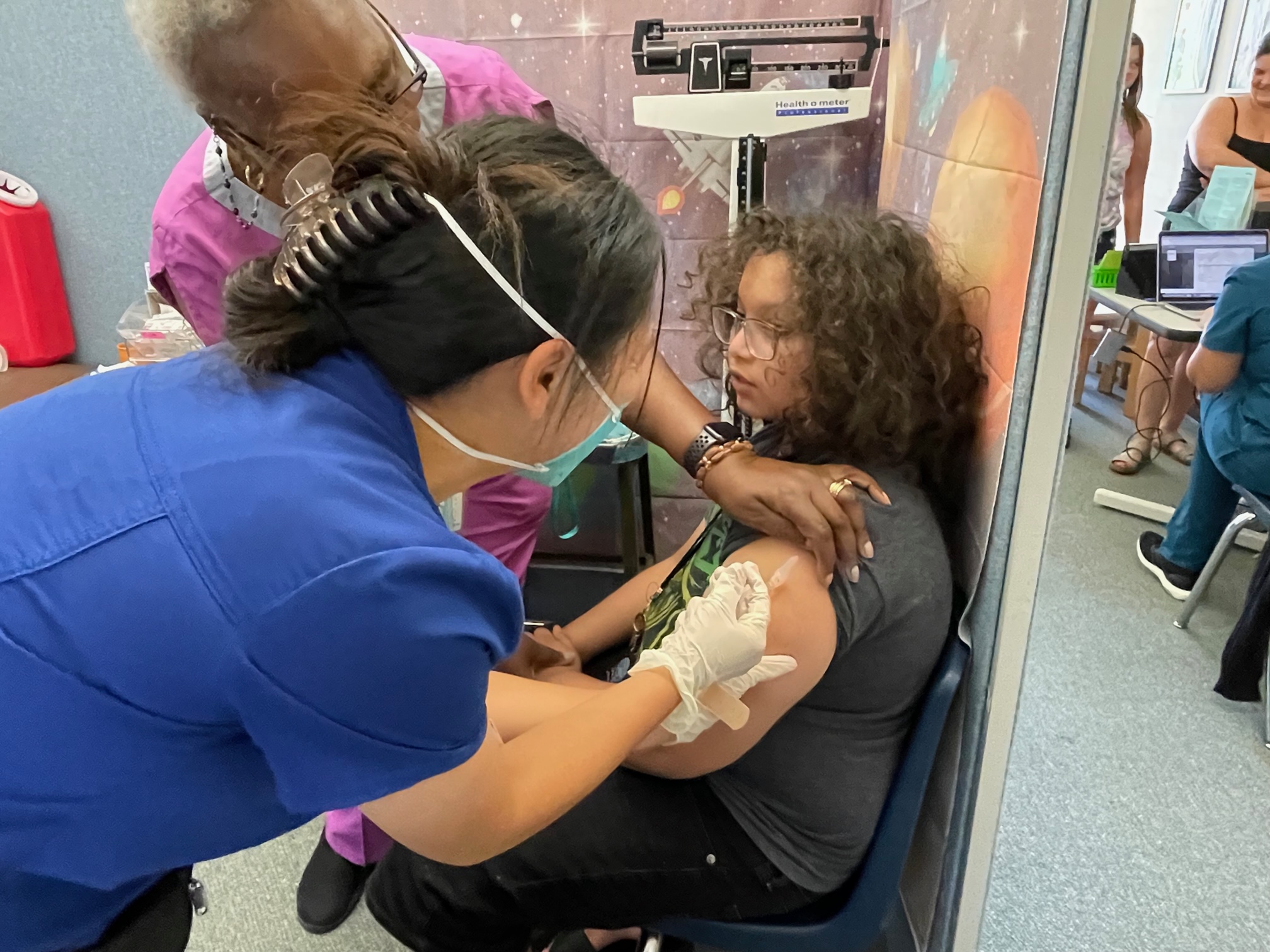
California law requires students to be vaccinated against 10 serious communicable diseases. Proof of immunization is required in kindergarten and seventh grade, as well as upon entering childcare, transitional kindergarten, or when transferring schools from out of state.
“This executive order will not change anything in California,” Pan said. “We are really committed to protecting access to vaccines for our communities.”
Which vaccinations are required in California?
California requires that children be immunized against 10 serious communicable diseases — diphtheria, Haemophilus influenzae type B (bacterial meningitis), measles, mumps, pertussis (whooping cough), polio, rubella, tetanus, hepatitis B and chicken pox — to attend public or private schools and child care centers.
Studies have linked clusters of unimmunized children to outbreaks of measles, pertussis and varicella or chicken pox.
Measles cases are increasing
The president’s executive order comes as measles cases in the U.S. hit a 35-year high. There have been 2,566 confirmed cases in the U.S. so far this year, compared to 2,289 confirmed cases during the entire year of 2025.
California has reported 58 cases of measles so far this year, up from 25 in 2025, according to the CDPH. All but 14 of the cases were people younger than 20, and all but four were either unvaccinated or their status was unknown, according to data from the California Department of Public Health.
Catherine Flores Martin, executive director of the California Immunization Coalition, worries that the number of cases nationwide could be higher.
“Some parents have gotten comfortable with not reporting their cases,” Flores Martin said. “So that is a big concern.”
Measles is highly contagious. About 90% of unvaccinated people who are exposed to someone with measles will contract the disease.
Flores Martin said requiring children to receive vaccinations over multiple visits could make it more difficult for lower-income parents.
“It will be way more onerous for parents and terrible for children,” Flores Martin said. “You know, the stress. I would say every time I went to the doctor as a child I was always stressed because I was worried about getting the shots.”
Is the order causing confusion?
Vaccines are safe and are continuously monitored and studied in the United States and California, Pan said. Still, she and other health experts worry that the White House announcement could create confusion about vaccinations just as students return to school.
Top health officials at San Diego Unified and Sacramento City Unified school districts told EdSource they have not noticed increased vaccine hesitancy this school year and have not received questions from parents about the president’s recommendations. That doesn’t mean parents have stopped raising concerns about vaccinations.
Sacramento City Unified lead nurse Susan Sivils reassures hesitant parents it is safe for their children to receive multiple vaccines in one visit.
“If they are uncomfortable with that, it is their decision as a parent,” Sivils said. “… But if they are set on that, then I just make sure they understand that until they are up to date with all of those vaccines, they won’t be allowed to start school.”
Sivils said she knows of only one family this year that chose to bring their child in for multiple visits to receive their vaccinations.
More parents are opting to wait to immunize their children until they are older, said Flores Martin.
“They say they are not hesitant, they just want to wait,” she said. “Those are informed, educated people, but what they’re deciding is very wrong from a scientific standpoint and a health standpoint for their children. So, we’re in uncharted territory because parents used to trust their doctor so much, but they’re not trusting them on this.”
State immunization rates high
California’s kindergarten vaccination rates remain above the national average of 92.4%. But the rates have been ticking down, from 95.6% during the 2016-17 school year to 93.7% in 2024-25. Measles vaccination rates are a little better with 96.1% of kindergartners vaccinated in 2024-25, compared to 97% in 2018-19.
Even relatively small declines can make a big difference in a state that had 355,391 kindergartners and 213,313 transitional kindergarten students last school year. A 1% drop in measles vaccinations, for example, means that there would be approximately 5,600 fewer students in those two grades who received the MMR vaccine.
The share of students with medical exemptions remains low, at about 0.1%. But state health experts say the number of students enrolled in home-based private schools or independent study programs without classroom-based instruction is increasing.
Although students in these schools don’t have to be vaccinated, their schools are required to maintain immunization records or risk losing some state funding.
Vaccination rates also are uneven across the state, with rural, charter and schools in low-income communities more likely to have under vaccinated students, according to the Public Policy Institute of California.
If the immunization rate falls below 95% in a school or community, that opens up the possibility of an outbreak, Pan said.
“So, yes, we want people to be up-to-date on their measles vaccine and make sure they have their two doses. That is part of the school vaccine requirements,” Pan said.

This story was originally published by EdSource.