AWARD-WINNING CONSERVATION PHOTOGRAPHERS Rob Badger and Nita Winter lived together lovingly for “one month short of 38 years” before getting married under a huge oak tree in a friend’s back yard in the hills of Mill Valley.
“We had to make sure it was going to work out,” explains Winter mischievously.

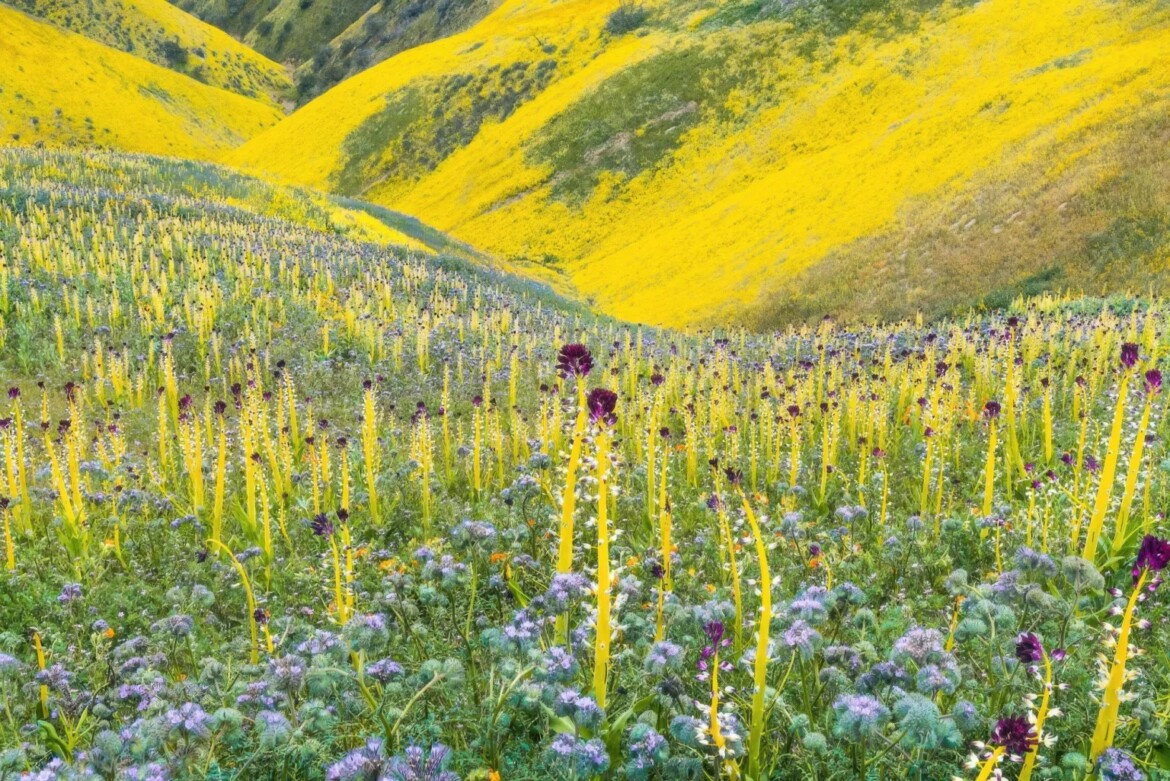
Badger and Winter had for three decades photographed flora in natural environments for their passion project, Beauty and the Beast: California Wildflowers and Climate Change, a 2020 coffee-table book that includes 190 color shots captured by natural light.
A companion exhibit of 52 framed photos, which preceded publication of the book and has been touring for seven years, has already been seen by 100,000 people.
Now they’re wrapping up the components of an innovative spinoff, Voices for the Splendor of California Wildflowers: A Descriptive Journey for the Visually Impaired, a labor-of-love audiobook that “will allow the visually impaired to see and connect with nature in their mind’s eye,” says Badger.
“We believe that no one has published an audio-described, beautiful coffee-table book where people can feel what it was like to be invited into our world and feel what kind of day it was when the images were shot,” he adds. “The poetically described photos can link directly with a listener’s imagination.”
The project, which highlights essays by scientists, environmental leaders, and nature writers, was inspired by the desire of a legally blind friend to “see” the striking images.
As part of the final stages before publication, which Badger and Winter hope to happen in the first quarter of 2026, they’re writing in-depth audio descriptions of their multi-colored, floral images, and they’ve gathered professionals in the world of sound to embellish those images and their stories. Becky Parker, founder and CEO of Pro Audio Voices, the company that will produce the audiobook, will voice those audio-descriptions.
Braille and Talking Books Libraries plans to reformat the book so it can be accessible to its 10,000 subscribers.
Peter Coyote lends his ‘iconic voice’
Actor Peter Coyote, famed for his roles in such classic movies as “E.T. the Extra-Terrestrial” and “Erin Brockovich” and for his narration on Ken Burns’ multi-part television documentaries, has narrated — from a studio in Sebastopol, near his home — “the personal short stories of seven male authors, the foreword, and ‘behind the scenes’ Badger-Winter text,” Winter reports.
Annie Obermeyer, Coyote’s actress friend, protégée, and what he labels “a force of nature,” reads 13 stories by female writers.

Winter and Badger sometimes echo each other’s thoughts. Case in point: “It was surreal for us to be sitting in a control room listening to Peter with his iconic voice reading our words.”
Coyote, who says he’s “been an environmentalist since I was about 6,” alludes in a phone interview to his “Buddhist philosophy about everything being interconnected.” He enjoys focusing on “the magical feelings I have about living creatures,” but maintains that human beings “are not different from water, from insects in the soil. You’ve never been free of the sun, of oxygen, of birds that are pollinating.”
Regarding his approach to narration, he admits, “I go into the studio naked to the text. If I’m open, the text itself will engender the appropriate emotions. I never prepare. My technique is no technique.”
Winter and Badger spent a lot of time fundraising for their exhibit, their coffee-table book, and for their audiobook, which Winter says is aimed in the final analysis “at the visually impaired, the blind, the dyslexic, non-English speakers, the sighted community, and, well, everyone.” Specifics are available on a crowdfunding page for the project.
“… We’ve spent so many hours outdoors looking at beauty and environmental destruction, and it’s become important to us to promote the beauty and public land, whether it’s a national park or a local city park.”
Rob Badger, nature photographer
The original idea for their coffee-table book, co-published by the California Native Plant Society, was birthed in 1992 after Liz Hyman, another outdoors photographer, invited Badger to join her in the Mojave Desert’s Poppy Reserve for a shoot. It started out too windy to photograph anything, but, soon thereafter, Badger watched “waves of intense warm wind blow across the poppies, (and) witnessed this amazing spectacle of color and beauty.”
Their work is crucial, he says, “because we’ve spent so many hours outdoors looking at beauty and environmental destruction, and it’s become important to us to promote the beauty and public land, whether it’s a national park or a local city park.”
Winter gently interrupts: “It’s always been about how can we make positive changes with our images — through visual storytelling.”
Relationship blossoms for Team Sweetie
Their own story is as compelling as their quest for California wildflowers. Their unconventional, humorous wedding ceremony, for instance, was pulled off without a hitch at a total cost of $610 by soliciting tables and chairs, plates and silverware, and flowers for each table. “It was a real community event in the sense that people contributed to our wedding,” explains Winter.

The two haven’t limited their interest in nature to distant sites. Winter says that “we’ve been “re-wilding our property, with 42 native plants, on a quarter of an acre on a hillside in Marin City, where there’s a steep slope with a lot of clay soil and where we have a really incredible view of the bay.”
Since they moved in 25½ years ago,” she says, “we’ve taken down five or six big Monterey Pine Trees, which are fire hazards, when they got sick, and juniper. When we bought the place, there was one Coastal Live Oak tree in the corner of the property. Birds carried seeds and we now have 20.”
Badger gently interrupts — and smiles impishly as he reveals how they jointly perceive their personal/creative relationship: “We are Team Sweetie.”
The post The sound of wildflowers: Photographers’ audiobook lets visually impaired ‘see’ nature appeared first on Local News Matters.